Why Buildings Fail RF Grid Tests (and How to Fix It)
A failed RF grid test can feel like a major setback, especially when your Certificate of Occupancy depends on it. However, failing is common, and the cause is usually predictable and fixable. This guide explains why buildings fail RF grid tests, how to read what failed, and the steps to reach a passing result.
- What counts as a failed RF grid test
- 8 common reasons buildings fail
- How to fix a failed test, step by step
- How to avoid failing in the first place
What Counts as a Failed RF Grid Test?
An RF grid test divides each floor into a grid of test areas and measures public safety radio signal strength and voice quality in each one. (New to the topic? Start with What Is RF Grid Testing?) The exact requirements depend on the fire code edition and local amendments your fire marshal, the Authority Having Jurisdiction (AHJ), enforces. Most jurisdictions use benchmarks like these:
Typical values. Check with your local AHJ for your building’s exact requirements.
Under recent editions of the International Fire Code (IFC), each floor is divided into 20 roughly equal test areas, each no larger than 6,400 square feet. If more than 5% of the test areas on a floor fail, which means more than 1 of 20, the floor fails. Some codes allow a failing floor to be divided into 40 smaller test areas and retested. Critical areas are tested separately and held to a higher standard.
A building can fail in three different ways:
8 Common Reasons Buildings Fail RF Grid Tests
1. Building Materials Block Radio Signals
Concrete, rebar, steel framing, metal roof decks and energy-efficient low-E glass all weaken radio signals. Energy-efficient buildings are a common example, because the window coatings that keep heat out also block radio frequency (RF) signals. As a result, a building that looks open and full of windows can still test poorly.
2. Below-Grade Levels and Interior Spaces
Basements, underground parking garages, mechanical rooms and the building’s interior core are the farthest from outside signal. Stairwells and elevator lobbies are often in that core, and they’re also critical areas, so they must pass at the higher 99% standard. For this reason, they’re among the most common areas to fail.
3. Distance From the Public Safety Radio Tower
Signal strength depends on how far your building is from the nearest public safety radio site, and on what’s in between. Hills, nearby high-rises and new construction next door can all weaken the signal reaching your building. That’s why two similar buildings in the same city can get very different results.
4. The Uplink Fails Even When the Downlink Passes
A radio tower transmits with far more power than a firefighter’s handheld radio. So a building may receive the network clearly while radios inside can’t reach the network. Both directions are tested, and either one can fail the building.
5. Strong Signal, Poor Voice Quality
Passing the signal strength number isn’t enough on its own. Radio interference, electrical noise and overlapping signals from multiple tower sites can make speech hard to understand. If voice quality falls below DAQ 3.0, the area fails, even with a strong signal.
6. Testing at the Wrong Time
Testing before the exterior walls, windows and roof are complete usually gives results that are too optimistic, because an unfinished building lets more signal in. The building passes early, then fails the official test later. Testing too late causes the opposite problem: if the test happens just before your Certificate of Occupancy, there’s no time to design and install a system if you fail.
7. Not Following Local Requirements
Many cities amend the fire code or publish their own ERRCS specifications. Tests can be rejected for testing the wrong frequencies, using grid sizes the AHJ doesn’t accept, missing critical areas, or using a tester without the required qualifications, such as an FCC General Radiotelephone Operator License (GROL) or NICET certification. A rejected report means testing again. For an example of how rules vary, see our guide to ERRCS requirements in Colorado.
8. Problems With an Existing ERRCS
Buildings that already have an Emergency Responder Radio Coverage System (ERRCS) can fail acceptance or annual testing too. Common causes include:
- The rooftop donor antenna is misaligned or pointed at the wrong tower site
- The bi-directional amplifier (BDA) gain is set too low, or too high, which adds noise to the public safety network
- Oscillation (feedback) caused by too little separation between the donor antenna and indoor antennas
- Damaged cables, connectors or antennas
- New coverage gaps from renovations or tenant build-outs after the system was installed
- Changes to the public safety radio network, such as new frequencies or tower sites
- Battery backup or alarm monitoring problems found during inspection
How to Fix a Failed RF Grid Test
Step 1: Read the Report Carefully
Start with the details. Which floors failed? Which test areas? Did the downlink, the uplink or voice quality fail? Were critical areas affected? The pattern points to the cause. For example, failures clustered in the basement and stairwells call for a different fix than scattered failures on every floor.
Step 2: Confirm the Requirements With Your AHJ
Before you design a fix, confirm which code edition and local amendments apply, which frequencies must be covered, whether a 40-area retest is allowed, and what approvals are required before a system is turned on.
Step 3: Match the Fix to the Cause
| What failed | Typical fix |
|---|---|
| Building materials or below-grade levels block signal | Install an ERRCS with indoor antennas covering the failing areas |
| Only one or two test areas fail | Retest using 40 test areas where allowed, or add coverage just for those areas |
| Uplink fails | Design the system so handheld radios inside can reach the network, and set uplink gain correctly |
| Poor voice quality | Find the interference source, then filter or tune the system |
| Tested too early | Retest once the exterior walls, windows and roof are complete |
| Report rejected | Retest with a qualified tester, following the local specification |
| Existing ERRCS fails | Realign the donor antenna, adjust gain, fix antenna separation, replace damaged parts or add antennas |
Step 4: Design and Install an ERRCS (If Needed)
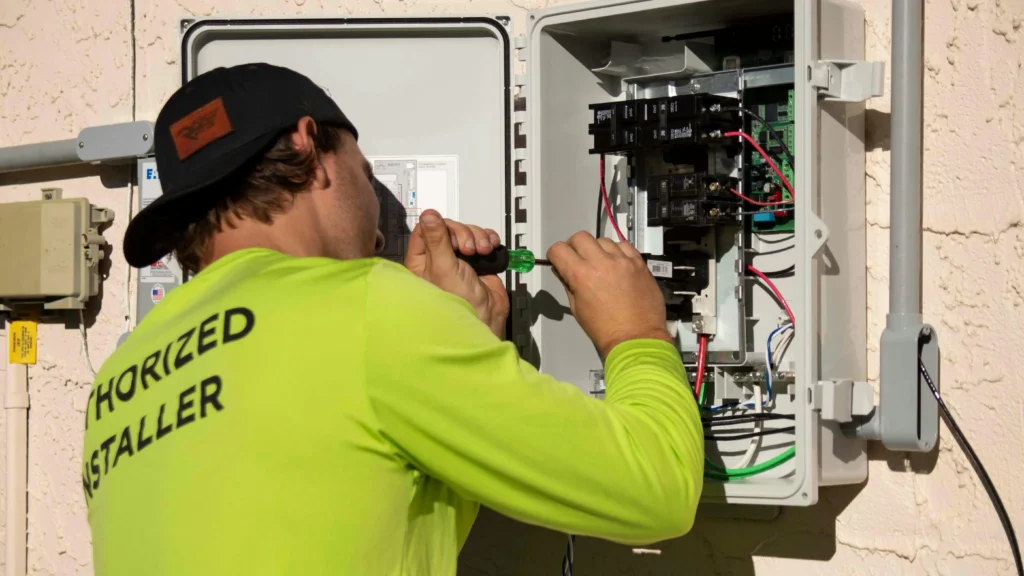
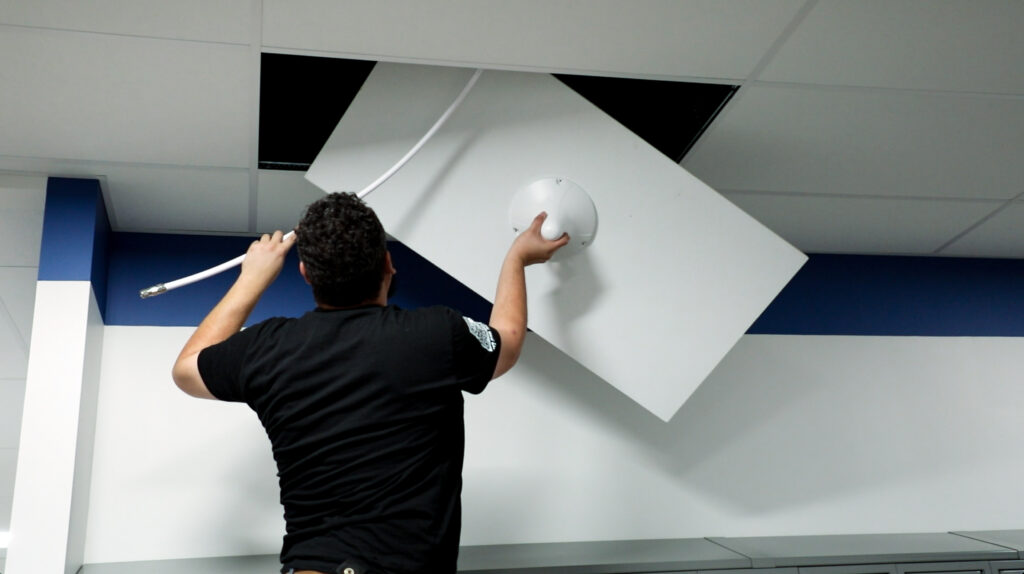
Most buildings that fail need an ERRCS, also called an Emergency Responder Communication Enhancement System (ERCES). It uses a bi-directional amplifier (BDA), a donor antenna on the roof, and indoor antennas connected by cable to bring the public safety signal inside. The process starts with BDA system design using the test results, then approval from the fire department and the radio network’s license holder, then ERRCS installation.
Step 5: Retest and Get Approval
After installation, an acceptance test uses the same grid method to confirm the building now passes. The report goes to your fire marshal for approval. From then on, the system must be tested every year, and after renovations that could affect coverage. Our ERRCS testing services cover acceptance and annual testing.
How to Avoid Failing in the First Place
- Ask your AHJ early which code edition and local requirements apply
- Schedule the RF grid test as soon as the exterior walls, windows and roof are complete
- In high-risk buildings (concrete, below-grade levels, low-E glass), plan cable pathways and equipment space for an ERRCS during design
- Use a qualified tester whose reports your AHJ accepts
- Retest after renovations, and keep up with annual testing if you have an ERRCS
Failed RF Grid Test FAQ
Does a failed RF grid test delay my Certificate of Occupancy?
Can a building pass a retest without installing an ERRCS?
What if only the uplink failed?
How long does it take to fix a failed RF grid test?
Send us your report. RFE Communications will find the cause and recommend the fix, from a simple retest to ERRCS design, installation and acceptance testing, with FCC GROL and NICET-certified testers.
Request a Quote