What Is RF Grid Testing? A Building Owner’s Guide to NFPA 1225 & IFC 510
In short, this guide explains everything a building owner needs to know about RF grid testing:
- What RF grid testing is and why fire codes require it
- Which buildings need to be tested
- What IFC 510 and NFPA 1225 require
- How the test works, step by step
- What to do if your building fails
Before a new commercial building can open, however, many fire departments want proof that firefighters’ radios will work inside during an emergency. RF grid testing is a floor-by-floor survey of public safety radio signal strength and voice quality, and it has two possible outcomes:
What Is RF Grid Testing?
RF grid testing, also called a radio coverage test, benchmark test, or ERRCS grid test, measures how well public safety radio signals reach every part of a building. To begin with, “RF” stands for radio frequency. Meanwhile, the “grid” is the method: each floor is divided into a grid of roughly equal test areas, and a technician measures the signal in each one. It answers two questions:
Commercial construction blocks radio signals in several ways. As a result, many buildings fail their first test:
- Concrete, steel framing and metal roofing
- Low-E and other energy-efficient glass
- Basements, parking garages and stairwells
- Elevator shafts and dense interior walls
Fortunately, RF grid testing shows exactly where coverage is lost, so an ERRCS can be designed to fix only the areas that need it.
Why RF Grid Testing Is Required
Today, most U.S. fire codes require buildings to provide reliable radio coverage for firefighters, police and EMS. The requirements come from two main sources:
Your local fire marshal, known as the Authority Having Jurisdiction (AHJ), decides which code and edition apply and whether your building must be tested. In addition, in many cities a passing RF grid test or an approved ERRCS is required before a Certificate of Occupancy is issued.
Which Buildings Need RF Grid Testing?
Triggers vary by jurisdiction, but RF grid testing is commonly required for:

However, thresholds differ from city to city. For this reason, ask your fire marshal early in design:
- Which fire code and edition apply to your building
- Whether your city has local amendments or its own ERRCS specification
- Which public safety radio network serves your area
- When the RF grid test should be scheduled
That way, you’ll have time to design and permit a system if you need one, without delaying your Certificate of Occupancy.
What NFPA 1225 and IFC 510 Require
The exact numbers depend on your code edition and local amendments, but most jurisdictions use requirements similar to these:
For example, critical areas usually include fire command centers, fire pump rooms, exit stairs, exit passageways, elevator lobbies and standpipe cabinets.
How RF Grid Testing Works
First, testing is usually done once exterior walls, windows, doors and roofing are in place. Otherwise, results can be too optimistic, because unfinished buildings let in more signal. Next, a common standard is 20 test areas per floor with a maximum of 6,400 sq ft each, though some AHJs set smaller areas. Finally, a qualified technician takes readings near the center of each area, and critical areas are tested separately because they must meet a higher standard.
Reading the RF Grid Test Report
The report shows floor plans with numbered grid areas, the measured values in each area, and a pass or fail result for each floor and critical area. It’s submitted to the fire marshal, and in some cities to the operator of the public safety radio network.
Who Can Perform RF Grid Testing?
Most jurisdictions require testers to hold an FCC General Radiotelephone Operator License (GROL) and in-building system training from an approved organization or the equipment manufacturer. A growing number also require NICET In-Building Public Safety Communications certification. For this reason, results from an unqualified tester may be rejected, which means testing again and potentially delaying your Certificate of Occupancy.
What Happens If Your Building Fails RF Grid Testing?
A failed test is common, especially in concrete buildings, buildings with energy-efficient glass and buildings with underground levels. However, it doesn’t mean your project is in trouble. Instead, it means the building needs an ERRCS, built around a bi-directional amplifier (BDA):
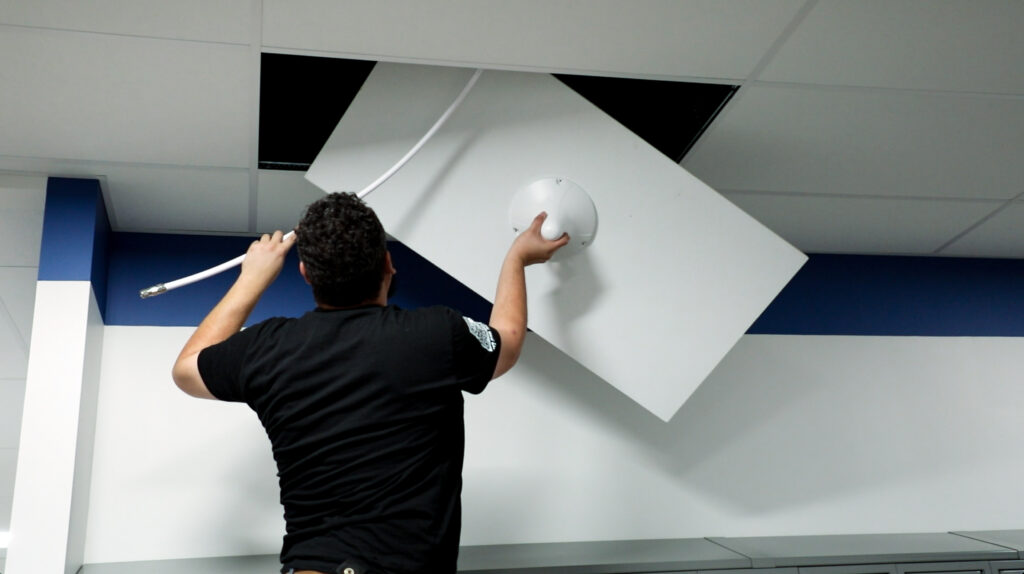
Because an ERRCS rebroadcasts public safety radio signals, it must follow FCC rule 47 CFR 90.219. In practice, that usually means:
- Written consent from the radio network’s license holder
- FCC-certified signal booster equipment, and UL 2524-listed equipment where required
- Registering Class B boosters with the FCC
- Approval from the radio network operator before the system is turned on
RF Grid Testing After the Building Opens
If your building has an ERRCS, it must be tested every year under IFC 510, and some jurisdictions also require a full coverage survey every five years. In addition, a building may need to be retested after:
- Tenant improvements or major renovations
- A change of occupancy
- New construction nearby that blocks the path to the closest radio tower
- Changes to the public safety radio network
RF Grid Testing FAQ
How long does RF grid testing take?
Is RF grid testing the same as ERRCS testing?
When should I schedule RF grid testing?
What’s the difference between NFPA 1225 and IFC 510?
Schedule RF Grid Testing With RFE Communications
RFE Communications has performed thousands of RF grid tests nationwide for new construction, renovations, and existing buildings. Learn more about our wireless grid testing services or find RF grid testing in your state.